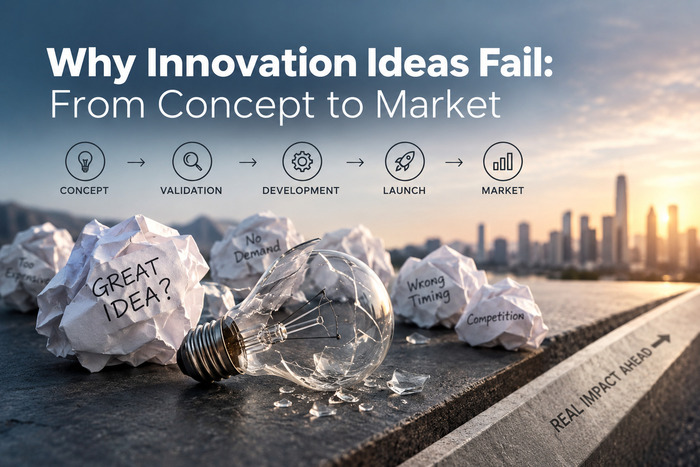
Innovation starts with an idea, but an idea alone rarely creates meaningful change. Many promising concepts fail to deliver measurable value because they lack validation, clear execution, or a path to scale. The innovation process provides a structured way to move from identifying a real opportunity to developing, testing, implementing, and expanding a solution. This guide breaks down each stage of that journey and explains how organizations can turn promising ideas into lasting impact.
What Is the Innovation Process?
The innovation process is a systematic approach organizations use to transform opportunities and ideas into solutions that create value. It connects creative thinking with practical decision-making, helping teams determine which ideas are worth pursuing, how they should be tested, and what it takes to bring them into real-world use.
Innovation is often confused with invention, but the two are not the same. Invention is the creation of something new, such as a technology, method, or product concept. Innovation occurs when a new or significantly improved idea is applied in a way that delivers value. Implementation is the execution phase—the work required to put that solution into practice.
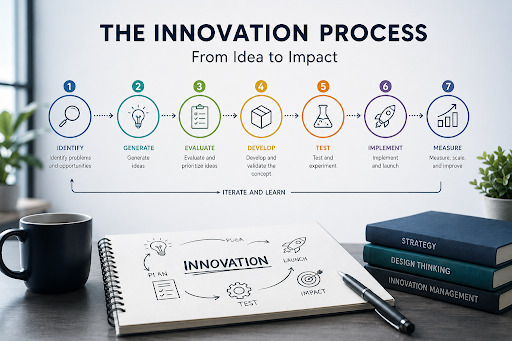
Although the innovation process is commonly presented as a sequence of stages, it is rarely linear in practice. Testing may reveal a flawed assumption, customer feedback may reshape a concept, or new information may send a team back to an earlier stage.
A typical process moves through opportunity identification, idea generation and evaluation, concept validation, experimentation, implementation, launch, and ultimately measurement and scaling.
Why a Structured Innovation Process Matters
Innovation always involves uncertainty. A structured process does not remove that uncertainty, but it helps organizations manage it before committing significant time, money, and resources. Instead of pursuing every promising idea, teams can evaluate opportunities, test assumptions, and gather evidence before making larger investments.
A well-defined innovation process helps organizations:
- Reduce risk and wasted investment by identifying weak ideas and flawed assumptions early.
- Prioritize the right opportunities based on customer value, strategic fit, feasibility, and potential impact.
- Align innovation with customer and business needs rather than developing solutions without a clear purpose or market demand.
- Experiment before scaling through prototypes, pilots, and other low-cost ways to validate a concept.
- Make innovation repeatable by creating a consistent framework teams can use instead of relying on occasional breakthrough ideas.
With this structure in place, organizations can make better-informed decisions while still leaving room for creativity, experimentation, and iteration.
The 7 Stages of the Innovation Process
While innovation rarely follows a perfectly straight path, breaking the process into stages gives teams a practical framework for moving from an initial opportunity to measurable results. Each stage answers a different question—from identifying what is worth solving to deciding whether a solution is ready to scale.
1. Identify Problems and Opportunities
Effective innovation starts with understanding the problem, not choosing a solution. When teams begin with a preferred product or technology, they risk investing in something customers do not need or that fails to address a meaningful business challenge.
Opportunities for innovation can emerge from many sources, including:
- recurring customer pain points;
- unmet or underserved market needs;
- inefficient internal processes;
- changes in customer behavior;
- emerging technologies and industry trends;
- regulatory or competitive shifts.
Organizations can uncover these opportunities through customer interviews, direct observation, market research, employee insights, and trend analysis. Combining several sources often provides a more complete picture than relying on assumptions or a single dataset.
The goal at this stage is to define the problem or opportunity clearly: Who is affected? What need is currently unmet? Why does it matter? A well-defined problem gives the rest of the innovation process a clear direction.
2. Generate Ideas
Once the problem is understood, the focus shifts from analysis to exploration. Idea generation is a form of divergent thinking: instead of immediately searching for the “best” answer, teams explore multiple ways to address the opportunity.
Ideas can come from both inside and outside the organization. Useful sources include employees, customers, suppliers, business partners, competitors, research institutions, and emerging technologies.
Common ideation methods include:
- brainstorming sessions;
- design thinking workshops;
- customer feedback and co-creation;
- employee suggestion programs;
- competitor and market analysis.
At this point, quantity can be valuable. Evaluating ideas too early may eliminate unconventional concepts before their potential is understood. By generating a broad range of possibilities first, teams create a stronger pool of options to evaluate in the next stage.
3. Evaluate and Prioritize Ideas
Generating ideas encourages exploration; evaluation introduces discipline. Organizations rarely have the resources to pursue every concept, so they need a consistent way to identify which opportunities deserve further investment.
A practical evaluation framework can score each idea against several criteria:
- Desirability: Does it solve a meaningful customer or user problem?
- Feasibility: Can the organization realistically build and deliver it?
- Viability: Can it create sustainable business value?
- Strategic fit: Does it support the organization’s priorities and capabilities?
- Potential impact: How significant could the customer or business outcome be?
Teams should also consider development costs, technical and market risks, resource requirements, and expected time-to-market.
A simple innovation matrix can assign each criterion a score—for example, from 1 to 5—and compare concepts using a weighted total. The purpose is not to predict success with mathematical certainty. It is to make prioritization more transparent and reduce decisions based solely on enthusiasm, hierarchy, or intuition.
4. Develop and Validate the Concept
A promising idea is still based on assumptions. Concept development turns it into something specific enough to examine, explain, and validate.
Teams should define the target user, the problem being addressed, the proposed solution, and its core value proposition. They should also identify critical assumptions—for example, whether customers actually experience the problem frequently enough, whether they would adopt the proposed solution, and whether the organization can deliver it effectively.
Instead of building the complete solution, teams can create:
- sketches or mockups;
- clickable prototypes;
- service simulations;
- proof-of-concept models;
- landing pages or concept demonstrations.
These tools make an abstract idea tangible and allow potential users to respond to something concrete. Early validation can reveal whether the concept deserves further investment—or needs to change before development continues.
5. Test and Experiment
Validation provides initial evidence, but experimentation tests whether the concept can work under more realistic conditions. Depending on the innovation, this may involve a minimum viable product (MVP), controlled experiment, limited pilot, beta release, or small-scale market test.
Teams should test the assumptions that could most seriously undermine the concept first. Waiting until late in development to discover a fundamental problem makes learning significantly more expensive.
Experiments can generate two types of evidence:
- Qualitative feedback explains what users think, experience, or struggle with.
- Quantitative data shows what users actually do through metrics such as adoption, conversion, retention, completion rates, or willingness to pay.
The process then becomes iterative: learn, adjust, and retest. Not every experiment needs to succeed. A failed test that disproves a critical assumption early can prevent a much larger investment in the wrong solution.
6. Implement and Launch
Once testing provides sufficient evidence, the focus shifts from proving the concept to delivering it reliably. Implementation turns a validated idea into a product, service, process, or business model that can function in the real world.
This stage often requires coordination across product development, engineering, operations, marketing, sales, finance, customer support, and leadership. Depending on the solution, organizations may also need new processes, employee training, technology infrastructure, partnerships, or compliance approvals.
Before launch, teams should address several questions:
- Is the solution operationally ready?
- Can customers access and understand it?
- Are employees prepared to support it?
- Is there a clear go-to-market plan?
- Can the organization handle increased demand?
The transition from prototype to full implementation is a common point of failure. A concept that works in a controlled pilot may encounter technical limitations, resistance to change, resource constraints, or unexpected customer behavior at scale. Strong execution is therefore just as important as the original idea.
7. Measure, Scale, and Improve
Launching a solution is not the end of the innovation process. Organizations need evidence that the innovation is creating the intended value—and that the value can be sustained as adoption grows.
Relevant key performance indicators (KPIs) depend on the objective but may include:
- customer adoption and retention;
- customer satisfaction or other user outcomes;
- revenue growth or new revenue streams;
- cost reductions;
- productivity and operational efficiency;
- time saved or process improvements.
Performance data helps teams decide what happens next. Strong results may justify expanding the solution to new customers, locations, or markets. Mixed results may require modifications or additional experiments. If evidence consistently shows limited value, stopping or pivoting the initiative may be the best decision.
Scaling also creates new information. Customer expectations change, competitors respond, technologies evolve, and previously hidden limitations emerge. Successful organizations use those insights to improve existing solutions and identify new opportunities—turning innovation from a one-time sequence into a continuous cycle of learning and improvement.
Innovation Process Example: From Idea to Impact
Consider a fictional regional healthcare provider operating 15 clinics across the Midwest. Patient feedback and call-center data reveal a recurring problem: patients often struggle to find convenient appointment times and spend too long rescheduling visits by phone.
Rather than immediately building a new scheduling system, the provider follows the innovation process:
- Identify the opportunity: Interviews and service data confirm that appointment management is a significant source of frustration for both patients and staff.
- Generate ideas: A cross-functional team considers several options, including extended call-center hours, automated text support, and a self-service scheduling portal.
- Evaluate ideas: The team compares each option based on patient value, cost, technical feasibility, and expected operational impact. The portal scores highest.
- Develop and validate: A clickable prototype is created and tested with a small group of patients. Their feedback leads to simpler navigation and clearer appointment options.
- Test and experiment: The provider pilots the portal at two clinics and tracks usage, scheduling completion rates, and support calls.
- Implement and launch: After positive pilot results, the system is integrated with existing scheduling workflows and introduced across all 15 clinics.
- Measure and scale: The organization monitors adoption, patient satisfaction, staff workload, and scheduling efficiency. Based on the results, it adds new self-service features and considers expanding the system to additional locations.
The example shows how each stage builds evidence for the next, reducing uncertainty before larger investments are made.
Common Challenges That Derail Innovation
Even with a defined process, innovation can lose momentum or produce disappointing results. Problems often arise when teams skip validation, make decisions based on assumptions, or focus more on launching an idea than proving its value.
Common innovation challenges include:
- Solving the wrong problem. Teams may develop an impressive solution for a customer need that is minor, misunderstood, or nonexistent.
- Becoming attached to an idea too early. Emotional investment can make teams ignore evidence that a concept needs to change—or should be abandoned.
- Weak customer validation. Internal opinions are not a substitute for feedback and behavioral data from actual users.
- Prioritizing hierarchy over evidence. Ideas should be evaluated against consistent criteria rather than selected simply because a senior leader supports them.
- Testing too late. Large investments made before critical assumptions are tested increase both cost and risk.
- Poor cross-functional alignment. Product, technology, operations, marketing, and other teams may have conflicting priorities or expectations.
- Lack of ownership. Without clear accountability, promising initiatives can stall between stages.
- Stopping at launch. Releasing a solution does not prove that it creates lasting value.
- Measuring activity instead of impact. The number of ideas, prototypes, or experiments matters less than outcomes such as adoption, customer value, revenue, or efficiency.
Recognizing these risks early helps organizations protect resources while keeping innovation focused on measurable outcomes.
How to Build a More Effective Innovation Process
An effective innovation process needs enough structure to guide decisions without becoming so rigid that it slows experimentation. The goal is to create an environment where teams can explore ideas quickly, test them objectively, and direct resources toward opportunities with the strongest evidence.
Organizations can strengthen their approach by following several practices:
- Set clear innovation goals. Define what innovation should achieve, whether that means improving customer experience, reducing costs, entering new markets, or creating new revenue streams.
- Use transparent evaluation criteria. Assess ideas consistently based on factors such as customer value, feasibility, strategic fit, risk, and potential impact.
- Involve customers early. Interviews, prototypes, and usability tests can expose incorrect assumptions before they become expensive.
- Start with small experiments. Test critical assumptions with low-cost pilots or prototypes before committing to full development.
- Build cross-functional teams. Combining expertise from product, technology, operations, marketing, and other functions improves both decision-making and execution.
- Make experimentation safe. Teams should be able to report unsuccessful tests and challenge assumptions without fear of blame.
- Use stage gates selectively. Review progress at key decision points without adding unnecessary approval layers.
- Measure learning and outcomes. Track what experiments reveal and what value innovations create—not simply how many ideas enter the pipeline.
Together, these practices create a process that combines disciplined decision-making with the flexibility innovation requires.
How Do You Measure Innovation Success?
Innovation success cannot be captured by a single metric. Measurement should reflect both how effectively an organization manages innovation and whether its initiatives ultimately create value.
A useful framework divides innovation metrics into three levels:
- Input metrics track what goes into innovation, such as funding, employee time, ideas submitted, and experiments launched.
- Process metrics measure how efficiently ideas move forward, including validation speed, time-to-market, experiment cycles, and the rate at which teams generate useful learning.
- Outcome metrics assess results, such as customer adoption, revenue generated, cost savings, customer satisfaction, productivity gains, or market impact.
The right KPIs depend on the initiative’s objective and maturity. An early-stage concept may be judged primarily by learning and validation, while a scaled innovation should demonstrate measurable customer or business outcomes. Using stage-appropriate metrics prevents organizations from expecting mature financial results from ideas that are still being tested.
From Ideas to Measurable Impact
Successful innovation requires more than creativity. It depends on a disciplined process for identifying meaningful opportunities, testing assumptions, executing solutions, and measuring results. By combining structure with continuous experimentation and learning, organizations can reduce uncertainty, make better decisions, and turn promising ideas into scalable solutions that deliver lasting impact.
FAQ
The innovation process typically includes seven stages: identifying problems and opportunities, generating ideas, evaluating and prioritizing them, developing and validating a concept, testing and experimenting, implementing and launching the solution, and measuring, scaling, and improving it.
There is no standard timeline. A simple process improvement may take weeks, while a new product, technology, or business model can require months or years. The timeline depends on complexity, resources, regulatory requirements, testing needs, and the level of uncertainty involved.
Invention refers to creating something new, such as a technology, method, or product. Innovation goes further by applying a new or significantly improved idea in a way that creates measurable value for customers, an organization, or the broader market.
No single stage guarantees success, but identifying the right problem is particularly important. If an organization starts with a poorly understood customer need or business opportunity, even strong ideation, development, and execution can result in a solution that delivers little meaningful value.