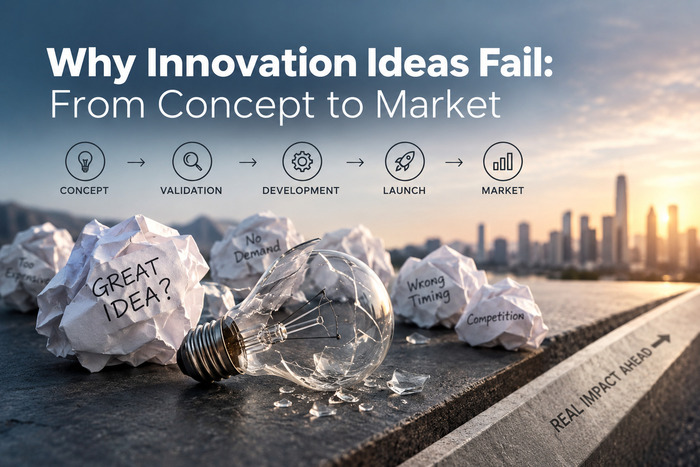
Innovation often begins with a promising idea, but turning that idea into a successful product is a different challenge. Even concepts that appear valuable can fail when customer needs are misunderstood, assumptions go untested, execution falls short, or the market simply does not respond as expected. Understanding where innovation breaks down—from initial concept and validation to development, launch, and adoption—helps businesses identify risks earlier and make better decisions before committing significant resources.
Why Do Good Innovation Ideas Fail?
A good idea is not necessarily a viable innovation. An idea may sound original, solve a real problem, or generate excitement within a company, yet still fail when exposed to customers, operational constraints, or market realities. Success depends on more than the strength of the concept itself.
A useful way to evaluate an innovation is through four connected factors: desirability, feasibility, viability, and adoption.
Desirability → Feasibility → Viability → Adoption
Desirability asks whether customers actually need the solution and value it enough to change their behavior. Feasibility determines whether the company can realistically build, deliver, and support it. Viability considers whether the idea can generate sustainable economic value after accounting for pricing, costs, competition, and scalability. Finally, adoption depends on whether the product can reach the right customers and overcome barriers such as switching costs, habits, or lack of trust.
Weakness at any one of these stages can undermine an otherwise promising concept. This is why innovation failure is rarely just about having a “bad idea.” More often, it results from assumptions that remain untested as the idea moves from concept to market.
Where Innovation Breaks Down: From Idea to Market
Innovation can fail at virtually any point between identifying an opportunity and achieving market adoption. Some problems originate in the idea itself, while others emerge during validation, development, commercialization, or launch. Understanding these failure points makes it easier to identify weak assumptions before they turn into expensive mistakes.
1. The Idea Solves the Wrong Problem
One of the earliest innovation failures happens when teams become attached to a solution before confirming that the underlying problem matters to customers. Instead of asking what customers struggle with, they start with a product or technology and search for a reason people should want it.
This solution-first approach often turns internal assumptions into supposed customer needs. A few positive conversations or enthusiastic reactions from colleagues can reinforce the belief that demand exists, even when there is little evidence of it.
Effective customer discovery helps challenge those assumptions. Interviews, observation, behavioral data, and problem-focused research can reveal how frequently customers experience a problem, how they currently solve it, and whether changing that behavior is important enough to them. Internal enthusiasm can help move a project forward, but it should never be mistaken for market demand.
2. The Concept Isn’t Validated Early Enough
Even when an innovation targets a genuine problem, companies can invest too much in building the solution before testing whether their assumptions are correct.
Customer feedback alone is not always sufficient. People may say they like an idea because they want to be helpful, because the concept sounds appealing in theory, or because they are not being asked to make a real purchasing decision. This can create false confidence.
Early validation should therefore focus on evidence, not just opinions. Prototypes can test usability and value propositions, MVPs can reveal actual behavior, and small experiments can measure interest before full-scale development begins. The longer validation is delayed, the more money and time become tied to the original concept. These sunk costs can make teams reluctant to change direction—even when new evidence suggests they should.
3. The Business Case Doesn’t Hold Up
Customer interest does not automatically translate into a sustainable business. A product may solve a real problem and receive positive feedback while still failing economically.
One common issue is the gap between interest and willingness to pay. Customers may want the product but reject the price required to make it profitable. Acquisition costs can also make growth expensive, while low margins limit how much a company can spend to reach and serve each customer.
Market size matters as well. A highly effective solution for a narrow audience may not have enough potential customers to support the expected investment. Other innovations work at a small scale but become significantly more expensive or complex as demand grows.
For this reason, product-market fit is only part of the equation. Pricing, unit economics, market size, acquisition costs, and scalability need to support the idea as a business—not simply as a product people like.
4. Execution Turns a Strong Idea Into a Weak Product
Sometimes the opportunity is valid, but the organization struggles to execute it.
Unclear ownership can leave important decisions without a responsible person. Scope creep adds features and requirements that increase development time without necessarily improving customer value. Slow decision-making can delay launches until the original opportunity has changed or competitors have moved ahead.
Technical constraints can further widen the gap between the original concept and what the company can realistically deliver. At the same time, poor coordination between product, engineering, marketing, sales, and leadership can result in teams working toward different definitions of success.
Strong innovation execution requires more than technical capability. It requires clear priorities, ownership, cross-functional alignment, and the discipline to protect the core customer value throughout development.
5. The Go-to-Market Strategy Comes Too Late
Building an innovation and bringing it to market are two different challenges. Yet companies often focus heavily on product development and address commercialization only when launch is approaching.
A product can fail because customers do not understand what makes it different, the positioning targets the wrong audience, or the chosen sales and marketing channels cannot reach buyers efficiently. Weak distribution can be particularly damaging: even a strong product cannot gain traction if customers rarely encounter it or cannot easily buy it.
Demand creation should therefore begin before launch. Teams need to determine who the initial customers are, why they should choose the new solution, how the product will reach them, and what will motivate them to act. A launch date is a milestone; it is not evidence that the market is ready.
6. The Market Doesn’t Adopt the Innovation
Even an innovation that performs well in development and launch can struggle with adoption. Customers rarely evaluate a new product in isolation—they compare it with what they already use and with the cost of changing.
Switching may require money, time, training, data migration, or changes to established workflows. Familiar habits can make an objectively better solution difficult to adopt. New products may also face trust barriers, especially when customers perceive financial, operational, privacy, or performance risks.
Timing matters too. An innovation can reach the market before customers are ready for it—or after competing alternatives have already become established. A steep learning curve can further reduce adoption if the perceived benefits do not justify the effort required to change.
This is why product-market fit alone does not guarantee success. Innovation ultimately depends on whether enough customers are willing and able to move from interest to actual, sustained use.
Warning Signs an Innovation Is Heading Toward Failure
Innovation rarely fails without warning. Problems often appear long before launch, but teams may overlook them because development is progressing, stakeholders remain enthusiastic, or too much has already been invested to reconsider the original assumptions. Several warning signs can indicate that an innovation is moving in the wrong direction:
- The team can describe the solution better than the customer problem. If features are clear but the specific customer need is difficult to explain, the project may be solution-driven rather than demand-driven.
- Validation relies mostly on opinions rather than behavior. Positive survey responses and interviews are weaker signals than purchases, sign-ups, repeated use, or other measurable actions.
- Customers like the idea but will not pay for it. Interest without willingness to pay can indicate that the perceived value is too low or the pricing model does not work.
- Development milestones exist, but commercialization milestones do not. A detailed product roadmap without plans for positioning, distribution, customer acquisition, and adoption leaves a major part of innovation untested.
- No one clearly owns the innovation from concept through launch. Fragmented responsibility can create gaps between strategy, development, and commercialization.
- The business case depends on unrealistic adoption assumptions. Aggressive growth projections can hide weak unit economics or limited demand.
- Marketing and sales enter the process only shortly before launch. Late involvement leaves little time to validate messaging, channels, buyer objections, or demand.
Any one of these signals does not automatically mean an innovation will fail. However, when several appear together, teams should reconsider their assumptions and gather stronger evidence before committing additional resources.
How to Reduce Innovation Failure Before Market Launch
Reducing innovation failure does not mean eliminating uncertainty. It means testing the most important assumptions before they become expensive commitments. A stage-gate approach can help teams move forward only when there is sufficient evidence to justify the next level of investment.
Validate the Problem Before the Solution
Start by confirming that the customer problem is real, frequent, and important enough to solve. Customer interviews can reveal motivations and frustrations, while observation and behavioral data show what people actually do. Teams should also look for evidence of existing demand, such as customers paying for alternatives or creating workarounds themselves. The goal is to validate the problem before becoming committed to a particular solution.
Test the Riskiest Assumptions First
Not every assumption deserves equal attention. Identify what would make the innovation fail if it proved false, then test that assumption first. For one concept, the biggest uncertainty may be customer demand; for another, it could be willingness to pay, technical feasibility, production costs, or market size. Prioritizing the highest-risk assumptions prevents teams from spending months validating details that do not determine whether the idea can succeed.
Build Evidence Through Small, Low-Cost Experiments
Investment should increase as evidence becomes stronger. A prototype can test whether customers understand and can use the solution. An MVP can measure real behavior with limited functionality, while a pilot can test the product under more realistic market conditions. Moving from prototype → MVP → pilot → launch creates opportunities to learn and adjust before the cost of failure increases.
Develop the Go-to-Market Plan Alongside the Product
Commercialization should not begin after development is complete. Teams should test positioning, pricing, target segments, distribution channels, and potential adoption barriers while the product is still evolving. Early go-to-market work can reveal problems that require changes to the product itself—not just its marketing.
Define Kill, Pivot, and Scale Criteria
Before each stage, establish measurable criteria for what happens next. Strong evidence may justify scaling; mixed results may require a pivot; consistently weak demand or economics may justify stopping the project.
Ending an innovation early should not automatically be considered a failure. A disciplined innovation process is designed to identify weak ideas before they consume significant resources and concentrate investment on opportunities supported by stronger evidence.
Innovation Failure Is a Process Problem, Not Just an Idea Problem
Most innovation ideas do not fail in a single dramatic moment. They fail through a series of untested assumptions—from the problem a company chooses to solve to the way the finished product reaches and wins customers. A promising concept can gradually lose its potential when weak evidence is accepted as validation, economic realities are addressed too late, or commercialization is treated as an afterthought.
This makes innovation failure as much a process problem as an idea problem. Companies cannot remove uncertainty from innovation, nor should they expect every initiative to reach the market. What they can do is create a process that exposes uncertainty before major commitments are made.
The goal of effective innovation management is therefore not to prevent every failure. It is to make failures earlier, less expensive, and more informative. When teams test critical assumptions, use evidence to guide investment, and remain willing to pivot or stop, unsuccessful ideas can still create value by preventing larger losses and improving the decisions behind the innovations that move forward.