Education is moving far beyond the traditional classroom. What began with computers, digital resources, and online learning has evolved into a more personalized, flexible, and increasingly AI-powered experience. Technology is not simply adding new tools to education—it is reshaping how students learn, how teachers teach, and what learning can achieve. From personalized instruction to greater accessibility, these changes are redefining education and shaping what its future may look like.
How Is Technology Changing Education?
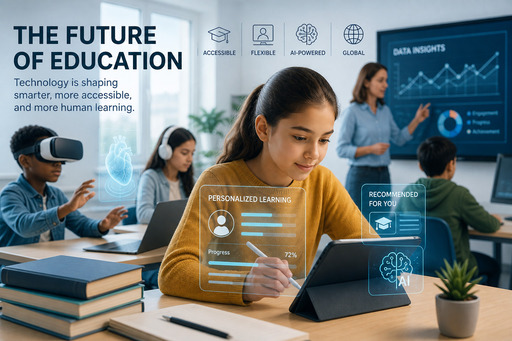
Technology is changing education by making learning more personalized, accessible, flexible, and data-driven. Instead of following the same learning path, students can increasingly receive content, feedback, and support tailored to their individual needs and progress. This creates opportunities for learners to study at their own pace while allowing teachers to identify areas where additional support may be needed.
At the same time, education is becoming less dependent on a physical classroom. Online courses, cloud-based learning platforms, and digital resources allow students to access lessons and educational materials from almost anywhere. This flexibility can benefit remote learners, working students, and people who might otherwise face barriers to education.
The change goes far beyond introducing laptops or tablets into classrooms. Artificial intelligence, learning analytics, immersive technologies, and automation are expanding what educational technology can do. AI-powered systems can support personalized learning, provide immediate feedback, assist with adaptive assessments, and analyze learning patterns.
Teachers are benefiting as well. Digital tools can help educators prepare materials, monitor student progress, assess performance, and automate routine administrative tasks. As a result, technology is not only changing how students learn but also giving teachers new ways to manage, understand, and improve the learning experience.
7 Ways Technology Is Shaping the Future of Education
Technology is influencing nearly every part of the learning experience, from how lessons are delivered to how student progress is measured. The following seven developments show where this transformation is having the greatest impact and what they could mean for the future of education.
1. Artificial Intelligence Is Transforming Teaching and Learning
Artificial intelligence is becoming one of the most influential forces in modern education. Generative AI can help create lesson materials, practice exercises, summaries, and other educational content, while AI-powered tutors can provide students with additional guidance when a teacher is not immediately available. These tools can also deliver instant feedback, helping learners recognize mistakes and improve without waiting for the next class.
For educators, AI can reduce the time spent on repetitive tasks. It can assist with grading, assessment, lesson preparation, progress tracking, and routine administrative work, giving teachers more time to focus on instruction and student interaction.
However, the growing role of AI does not mean replacing teachers. Its greatest potential lies in supporting them. Human educators still provide judgment, context, motivation, and personal connection—qualities technology cannot fully replicate. Used effectively, AI can strengthen these human aspects of education rather than compete with them.
2. Personalized Learning Is Becoming the New Standard
Technology is making it possible to move away from a one-size-fits-all approach to education. Adaptive learning platforms can analyze how students perform and adjust lessons, exercises, and difficulty levels based on their individual needs. This allows learners to progress at different speeds rather than forcing an entire class to follow the same path.
Real-time performance data makes this personalization even more effective. Digital platforms can identify areas where a student is struggling, recognize topics they have already mastered, and provide targeted recommendations for what to study next. A learner who needs more practice with a concept may receive additional exercises, while another can move on to more challenging material.
AI is accelerating this shift by helping educational systems respond to student needs more quickly and precisely. For teachers, these insights can make it easier to provide individualized support while still managing the needs of an entire class.
3. Online and Hybrid Learning Are Expanding Access
Education is no longer limited by the location of a classroom or a fixed daily schedule. Online courses and hybrid learning models give students more freedom to choose where, when, and sometimes how they study. This flexibility can make education more accessible to people who live far from schools or universities, balance learning with work or family responsibilities, or simply need a different study schedule.
Hybrid classrooms combine in-person instruction with digital resources and remote participation, allowing learning to continue beyond scheduled class time. Students can access lectures, assignments, discussions, and study materials from almost anywhere with an internet connection.
This shift also supports lifelong learning. Professionals can develop new skills, earn qualifications, or explore new subjects without necessarily leaving their jobs or relocating. As education becomes more flexible, learning is increasingly becoming an ongoing process rather than something confined to a particular place or stage of life.
4. Virtual and Augmented Reality Are Making Learning More Immersive
Virtual and augmented reality can turn abstract concepts into experiences students can see and interact with. Instead of simply reading about ancient Rome, for example, students could explore a virtual reconstruction of the city. Medical students can examine interactive 3D models of the human body, while science and engineering students can practice complex or potentially dangerous procedures in simulated environments.
These technologies are particularly valuable for experiential learning, where understanding develops through practice rather than observation alone. Virtual environments can also provide access to laboratories, field trips, and training scenarios that may be difficult, expensive, or unsafe to recreate in the real world.
However, widespread adoption remains a challenge. VR and AR equipment can be costly, and institutions need suitable infrastructure, technical support, and relevant educational content. As these technologies become more affordable and scalable, immersive learning could play a much larger role in classrooms, universities, and professional training.
5. Data Analytics Is Helping Educators Make Better Decisions
Digital learning platforms generate valuable data about how students learn, where they struggle, and how quickly they progress. Learning analytics can help educators track performance in real time, identify knowledge gaps, and recognize students who may need additional support before they fall significantly behind.
These insights can also improve teaching decisions. Rather than relying only on test results or classroom observations, educators can use data to see which lessons are effective, where students repeatedly encounter difficulties, and which learning materials produce better outcomes. Schools and universities can apply similar insights to evaluate courses and improve curricula over time.
The goal is not to replace professional judgment with numbers, but to give educators a clearer picture of student needs. When used responsibly, learning analytics can support earlier intervention, more targeted instruction, and better-informed decisions at both the classroom and institutional levels.
6. Technology Is Making Education More Accessible
One of technology’s most important contributions to education is its potential to remove barriers to learning. Assistive technologies such as speech-to-text, text-to-speech, screen readers, and captioning tools can make educational content easier to access for students with different needs. Translation tools can also help learners overcome language barriers and participate more fully in lessons.
Digital platforms extend this access beyond the classroom. Students in rural or remote areas can connect to courses, teachers, and educational resources that may not be available locally. Combined with flexible online learning, these tools can open educational opportunities to a much wider range of learners.
However, greater digital access does not automatically mean equal access. Students still need reliable internet connections, suitable devices, and the skills to use digital tools effectively. Without these resources, technology can reinforce the digital divide rather than close it. Making education truly more accessible therefore requires investment in infrastructure, inclusive design, teacher preparation, and responsible use of technology.
7. Students Are Being Prepared for an AI-Driven Workforce
Technology is changing not only how students learn but also what they need to learn. As artificial intelligence becomes part of more industries and professions, AI literacy and broader digital skills are becoming increasingly important. Students need to understand how to use AI tools effectively, recognize their limitations, and critically evaluate AI-generated information rather than simply accepting it as accurate.
At the same time, an AI-driven workplace may increase the value of distinctly human abilities. Critical thinking, creativity, problem-solving, communication, and collaboration can help students work alongside technology and adapt when tools or job requirements change.
This makes lifelong learning increasingly important as well. The skills required for a career may continue to evolve long after formal education ends. Preparing students for the future therefore means more than teaching them how to use today’s technology. Education must help them develop the judgment, adaptability, and willingness to keep learning that they will need in a rapidly changing workforce.
How Technology Is Changing the Role of Teachers
As technology becomes more integrated into education, the role of the teacher is evolving. Teachers are no longer expected to be the primary source of information in a classroom where students can access knowledge instantly. Instead, their role is increasingly shifting toward that of a facilitator, mentor, learning designer, and guide who helps students navigate both educational content and digital tools.
Technology can support this transition by reducing time spent on routine tasks. AI and digital platforms can assist with lesson planning, grading, administrative work, and the creation of materials for students with different learning needs. Learning analytics can also help teachers identify struggling students earlier and provide more targeted support.
However, greater automation does not make teachers less important. Technology cannot fully replicate human judgment, empathy, motivation, or the ability to understand the social and emotional needs of individual students. Teachers also play a critical role in encouraging discussion, developing critical thinking, and helping students evaluate information—including content produced by AI.
The future teacher, therefore, is unlikely to be replaced by technology. Instead, educators will increasingly need to understand how to use it responsibly while preserving the human relationships that make learning meaningful.
Challenges of Technology in Education
Technology brings significant opportunities to education, but its benefits also come with challenges that schools and educators need to address.
The Digital Divide
Not every student has reliable broadband, suitable devices, or equal access to digital resources. Without adequate infrastructure, technology can widen existing socioeconomic inequalities.
Student Data Privacy and Security
Digital learning and AI platforms can collect large amounts of student data. Schools must consider how this information is stored, protected, and used.
AI Bias and Academic Integrity
AI systems can produce biased or inaccurate information, while easy access to generative AI raises concerns about cheating and overreliance on automated answers. Students need guidance on using these tools critically and responsibly.
Too Much Technology
More technology does not automatically lead to better learning. Excessive screen time, digital distractions, and dependence on automated tools can interfere with focus and independent thinking.
The future of education is not about using as much technology as possible, but about choosing the right technology for the right educational purpose.
Conclusion
Technology is reshaping education in ways that extend far beyond digital classrooms. AI, personalized learning, online platforms, immersive experiences, and data-driven tools are creating new opportunities to make learning more flexible, accessible, and responsive to individual needs. At the same time, these changes make responsible technology use, digital literacy, and human guidance increasingly important.
The future of education is not one in which technology replaces teachers or removes the human element from learning. Instead, technology can give educators and students better ways to connect, teach, learn, and adapt. Ultimately, the most successful education systems will not be those that adopt the most technology, but those that use it thoughtfully to make learning more personalized, accessible, engaging, and human.