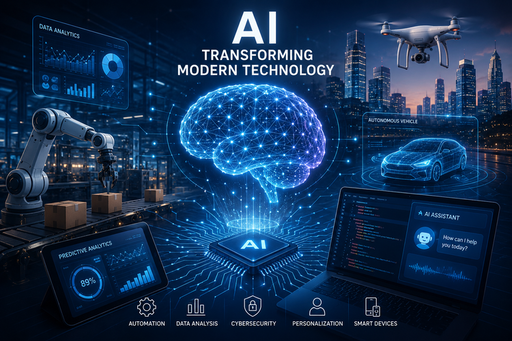
Artificial intelligence is transforming modern technology by making systems smarter, faster, and more adaptive. From automating complex tasks and analyzing large amounts of data to improving decision-making and personalizing digital experiences, AI is changing how technology works and how people use it. As AI becomes increasingly integrated into software, devices, and infrastructure, its impact continues to expand across industries and everyday life.
What Is Artificial Intelligence?
Artificial intelligence (AI) refers to technologies that enable computers and machines to perform tasks that typically require human intelligence. These include learning from experience, recognizing patterns, understanding language, solving problems, and making decisions. Unlike traditional software that relies primarily on predefined rules, AI systems can analyze data and improve their performance over time.
Key Technologies Behind AI
Modern AI combines several technologies. Machine learning allows systems to learn from data, while deep learning uses neural networks to handle more complex patterns and large datasets. Natural language processing (NLP) enables machines to understand and generate human language, while computer vision helps them interpret images and video. Generative AI goes a step further by creating new content, including text, images, audio, and code. Together, these technologies form the foundation of many AI-powered tools and systems used today.
How Is AI Transforming Modern Technology?
AI is changing modern technology by allowing systems to move beyond fixed instructions and respond more intelligently to data, users, and changing conditions. Its impact can already be seen across digital platforms, business operations, software development, security, and connected devices.
Automation and Smarter Workflows
Traditional automation follows predefined rules: when a specific condition occurs, the system performs a predetermined action. AI makes automation more flexible. AI-powered systems can analyze information, identify patterns, and adjust their actions based on new data.
Businesses use intelligent automation to process documents, manage routine administrative tasks, and improve customer support. In manufacturing, AI can monitor equipment and detect potential problems before they cause downtime. Customer service systems can classify requests, generate responses, and direct complex cases to human agents. This allows organizations to automate more than repetitive tasks while keeping people involved where judgment is required.
Data Analysis and Decision-Making
Modern organizations generate enormous amounts of data, but extracting useful insights from it can be difficult. Traditional analytics often focuses on explaining what has already happened. AI-powered analytics can go further by identifying complex patterns, predicting possible outcomes, and processing information at a scale that would be difficult to manage manually.
Machine learning models, for example, can analyze historical and real-time data to forecast demand, detect unusual activity, or identify emerging trends. These capabilities help businesses make faster, data-driven decisions and respond more effectively to changing conditions.
Software Development
AI is also transforming how software is created and maintained. AI coding assistants can generate code, suggest improvements, explain unfamiliar functions, and help developers identify errors. They can also support automated testing, documentation, and debugging.
Rather than replacing developers, these tools can reduce the time spent on repetitive programming tasks and allow teams to focus more on architecture, problem-solving, and product development. Generative AI is further changing software interfaces by allowing users to interact with applications through natural-language commands instead of relying entirely on traditional menus and controls.
Cybersecurity
Cybersecurity systems increasingly use AI to analyze network activity, detect anomalies, identify potential fraud, and respond to threats. Because machine learning models can process large volumes of security data quickly, they can help identify suspicious behavior that traditional rule-based tools may miss.
However, AI also introduces new risks. Cybercriminals can use generative AI to create more convincing phishing content or automate parts of an attack. As a result, AI is becoming both an important cybersecurity tool and a technology that security teams must learn to defend against.
Personalization and Human-Computer Interaction
AI has made digital experiences increasingly personalized. Recommendation systems can analyze user behavior to suggest products, videos, music, or other content based on individual interests. Similar technology helps platforms customize search results, advertising, and user experiences.
Conversational AI is also changing how people interact with technology. Chatbots and virtual assistants allow users to communicate with systems using natural language, while multimodal AI can work with combinations of text, images, audio, and video. These developments are making human-computer interaction more intuitive and flexible.
Intelligent and Autonomous Systems
One of the most significant changes is the development of systems that can perceive their environment and make decisions with limited human intervention. AI powers industrial robots, autonomous vehicles, smart devices, and many Internet of Things (IoT) applications.
Edge AI extends these capabilities by processing data directly on devices rather than sending everything to remote cloud servers. This can reduce latency and enable faster responses in technologies such as vehicles, cameras, industrial equipment, and smart home devices. Together, AI, robotics, IoT, and edge computing are pushing modern technology toward increasingly intelligent and autonomous systems.
How AI Is Transforming Major Industries
Beyond changing individual technologies, AI is reshaping entire industries by improving efficiency, supporting faster decisions, and creating new ways to deliver products and services. Its applications vary by sector, but the common goal is to use data more effectively and automate processes that once required significant human effort.
Healthcare
In healthcare, AI helps professionals analyze medical data and identify patterns that may support faster and more accurate diagnoses. Computer vision can assist with medical imaging, while predictive models can help assess patient risks and support personalized treatment decisions. AI is also being used in drug discovery to analyze potential compounds and accelerate early stages of research. These tools are designed to support medical professionals rather than replace clinical judgment.
Finance
Financial institutions use AI to detect fraud, assess risk, analyze transactions, and automate routine operations. Machine learning models can identify unusual activity across large volumes of financial data, helping organizations respond to potential fraud more quickly. AI-powered systems also support customer service, credit analysis, and financial forecasting.
Manufacturing
AI is helping manufacturers create smarter and more efficient production environments. AI-powered robots can perform repetitive or highly precise tasks, while computer vision systems can identify product defects during quality control. Predictive maintenance is another major application: by analyzing equipment data, AI can detect signs of potential failure before a machine breaks down, reducing unexpected downtime and maintenance costs.
Transportation
Transportation is becoming increasingly data-driven through AI. Navigation platforms use real-time information to predict traffic and optimize routes, while logistics companies can improve delivery planning and fleet management. AI is also central to the development of autonomous and driver-assistance systems, which use cameras, sensors, and machine learning to interpret surrounding environments.
Similar changes are taking place in retail, where AI supports recommendations and demand forecasting, and in education, where it can help personalize learning experiences and automate administrative tasks.
Benefits of Artificial Intelligence in Technology
The growing use of AI offers practical benefits that extend across industries and applications. By combining automation with advanced data analysis, AI can improve how quickly and efficiently technology performs everyday and complex tasks.
- Greater efficiency and productivity: AI can automate repetitive processes, assist employees with complex workflows, and reduce the time required to complete routine tasks.
- Faster data processing: AI systems can analyze large datasets and identify useful patterns much faster than manual analysis, supporting quicker decision-making.
- Improved accuracy: In areas such as manufacturing, cybersecurity, and medical imaging, AI can help detect anomalies, defects, or patterns that may otherwise be difficult to identify.
- Reduced operational costs: Automation, predictive maintenance, and better resource allocation can help organizations reduce downtime and unnecessary expenses.
- Better personalization: AI allows digital platforms to tailor recommendations, services, and experiences based on user behavior and preferences.
- Faster innovation: Generative AI, predictive models, and AI-assisted development can accelerate research, software creation, and product development.
- 24/7 automation: AI-powered systems can monitor processes, handle routine requests, and analyze incoming data continuously without being limited to standard working hours.
Together, these advantages make AI an important driver of more responsive, efficient, and adaptable technology.
Challenges and Risks of AI
Despite its benefits, AI also introduces challenges that organizations must address as the technology becomes more widely adopted. Responsible implementation requires attention to data protection, fairness, reliability, and the broader impact of automation.
Privacy and Security
AI systems often depend on large amounts of data, which can create privacy concerns when personal or sensitive information is collected, stored, or processed. AI can also introduce new security vulnerabilities, while malicious actors may use the technology for phishing, fraud, and other cyber threats. Strong data governance and cybersecurity measures are therefore essential.
Bias and Transparency
AI models learn from existing data, which may contain historical or social biases. As a result, AI-generated decisions can sometimes produce unfair or inaccurate outcomes. Another challenge is transparency: complex models may not always make it clear why a particular recommendation or decision was made. This is especially important when AI is used in areas such as finance, employment, or healthcare.
Reliability and Human Oversight
AI systems can make mistakes, generate inaccurate information, or perform poorly when faced with unfamiliar situations. Human oversight remains important, particularly for high-impact decisions.
Wider AI adoption also raises concerns about job displacement as some tasks become automated. At the same time, organizations face evolving regulatory requirements and the significant computing power and energy demands of advanced AI models. Addressing these issues will be critical to making AI both useful and sustainable.
The Future of AI and Modern Technology
The next phase of AI is likely to move beyond systems that primarily generate content or respond to individual prompts. AI agents, also known as agentic AI, are being developed to plan tasks, make decisions, use digital tools, and complete multi-step workflows with greater autonomy. This could change how businesses automate processes and how people interact with software.
At the same time, edge AI is bringing more AI processing directly to smartphones, vehicles, cameras, industrial equipment, and other connected devices. Processing data locally can reduce latency, improve responsiveness, and decrease reliance on constant cloud connectivity.
AI is also becoming more closely integrated with robotics and autonomous systems, enabling machines to better perceive and respond to physical environments. These advances could expand automation in manufacturing, logistics, transportation, and other sectors.
However, the future of AI is not simply about replacing human work. Many applications are likely to focus on human-AI collaboration, with AI acting as a copilot that supports analysis, creativity, and decision-making while people provide judgment and oversight.
As AI capabilities expand, responsible AI will become equally important. Strong governance, safety standards, transparency, and accountability will be necessary to ensure that increasingly powerful AI systems are developed and used responsibly.
Conclusion
Artificial intelligence is shifting technology from systems that simply follow predefined instructions toward systems that can learn, predict, generate, adapt, and increasingly act autonomously. This evolution is creating new possibilities for businesses, industries, and everyday digital experiences. Yet the long-term value of AI will depend on more than technological capability alone. The most effective future will combine AI’s speed and analytical power with human judgment, creativity, and oversight. Responsible adoption will be essential to ensuring that AI-driven innovation remains reliable, transparent, and beneficial.
Frequently Asked Questions
AI is making technology more adaptive, automated, and data-driven. It enables systems to analyze large datasets, recognize patterns, generate content, personalize user experiences, and make predictions. AI is also helping automate increasingly complex workflows that previously required significant human involvement.
AI is used across many modern technologies, including smartphones, search engines, recommendation systems, virtual assistants, cybersecurity platforms, cloud services, robots, autonomous vehicles, and Internet of Things (IoT) devices. It also plays an increasing role in software development, healthcare technology, manufacturing systems, and financial platforms.
The main benefits of AI include greater efficiency, faster data processing, improved accuracy, better personalization, and increased automation. AI can also reduce operational costs, support faster decision-making, and help organizations develop new products and services more efficiently.
The future of AI is likely to include more capable AI agents, edge AI, autonomous systems, and closer integration with robotics and everyday devices. Human-AI collaboration will also become increasingly important, with AI supporting people in analysis, creativity, and decision-making while responsible governance helps manage emerging risks.