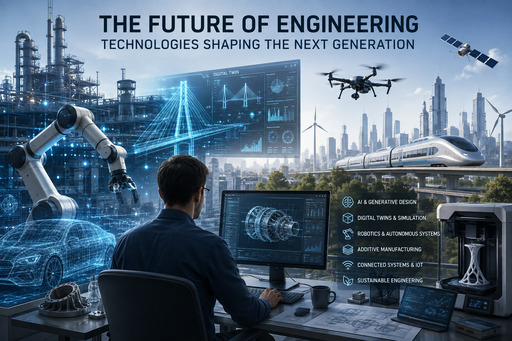
US employers are asking engineers to do more than solve technical problems. As AI, automation, advanced manufacturing, and digital systems reshape industries, companies increasingly need engineers who can work across technologies, interpret data, communicate with multidisciplinary teams, and make sound decisions in complex environments. Technical expertise remains the foundation, but the engineers who stand out over the next decade will be those who can combine it with adaptability, digital fluency, and strong judgment.
Why Engineering Skills Are Changing
The skills expected from engineers in the United States are evolving alongside the technologies and industries they support. AI and automation are taking over more routine tasks, from generating code and analyzing data to assisting with design, simulation, and predictive maintenance. As these tools become part of everyday engineering workflows, employers increasingly value people who can use them effectively while recognizing their limitations and validating their outputs.
At the same time, investment in advanced manufacturing, semiconductor production, energy systems, and infrastructure is creating more technically complex environments. Modern engineering projects rarely fit neatly within a single discipline. A semiconductor facility, smart factory, power grid, or transportation system can involve mechanical and electrical engineering, software, data, cybersecurity, materials science, and operations working together.
This shift makes interdisciplinary thinking increasingly important. Engineers still need strong technical foundations, but they also need to understand how their decisions affect other components, teams, costs, safety requirements, and business objectives.
The result is a broader definition of engineering competence. Technical knowledge remains essential, but US employers are placing greater value on engineers who can work with emerging technologies, collaborate across disciplines, interpret complex information, and adapt as tools and requirements change.
1. AI and Automation Literacy
AI literacy is quickly becoming a practical engineering skill rather than a specialty reserved for software or machine learning teams. The key is not simply knowing how to use AI, but understanding where it can improve engineering work and where human expertise must remain in control.
Using AI as an Engineering Tool
Engineers can increasingly use AI-assisted tools to accelerate design iterations, generate or review code, analyze large datasets, support simulations, detect anomalies, and optimize processes. In manufacturing, for example, AI can help identify equipment problems before failures occur. In design workflows, it can help engineers explore more alternatives in less time.
This changes the engineer’s role from performing every step manually to defining problems, selecting appropriate tools, interpreting results, and deciding which outputs deserve further investigation. Engineers who understand both their domain and the capabilities of AI will be better equipped to use automation productively rather than simply follow its recommendations.
Knowing Where AI Cannot Be Trusted
AI-generated output is not automatically an engineering-grade result. Models can produce incorrect calculations, rely on inappropriate assumptions, overlook physical constraints, or generate plausible-looking answers that fail under real-world conditions.
That makes verification a critical skill. Engineers must be able to test AI outputs against specifications, simulations, established standards, safety requirements, and fundamental engineering principles. As automation expands, engineering judgment may become more valuable—not less—because someone still has to determine whether a result is accurate, safe, and suitable for its intended application.
2. Data Literacy and Computational Thinking
Modern engineering generates enormous amounts of data, from sensor readings and production metrics to simulation results and equipment performance records. The ability to work with this information is becoming a core engineering skill. Engineers need to know how to identify relevant data, recognize patterns, question its quality, and translate findings into practical decisions.
Computational thinking supports this process. Basic programming skills can help engineers automate repetitive calculations, process large datasets, build simple models, and test different scenarios more efficiently. Modeling and simulation also allow teams to evaluate designs and operating conditions before committing time and resources to physical prototypes or real-world changes.
This does not mean every engineer needs to become a data scientist or professional software developer. The more important skill is understanding how data and computational tools can support engineering judgment. An engineer should be able to determine what information matters, understand the assumptions behind a model, and recognize when results require further validation.
As engineering systems become more connected and data-rich, professionals who can turn raw information into useful insights will have an advantage. Data literacy is increasingly becoming part of how engineers diagnose problems, compare alternatives, optimize performance, and make evidence-based decisions.
3. Systems Thinking
Engineering problems increasingly exist within larger, interconnected systems. A change that improves the performance of one component can create new challenges elsewhere, affecting reliability, cost, energy use, maintenance, or safety. Systems thinking helps engineers understand these relationships instead of evaluating individual components in isolation.
Seeing Beyond a Single Component
Modern systems often combine hardware, software, data, people, supply chains, and physical infrastructure. Engineers therefore need to consider not only whether a component works, but how it interacts with everything around it. A technically superior design may still be a poor solution if it is difficult to manufacture, expensive to maintain, vulnerable to supply disruptions, or incompatible with existing systems.
This perspective is especially important in fields such as robotics, aerospace, energy, advanced manufacturing, and infrastructure. These environments involve numerous technical disciplines as well as economic, operational, regulatory, and environmental constraints.
Systems thinking allows engineers to anticipate trade-offs and unintended consequences earlier in the design process. As projects become more complex, employers will increasingly need engineers who can connect technical details to the performance and objectives of the system as a whole.
4. Cybersecurity and Digital Risk Awareness
Cybersecurity is no longer relevant only to software engineers and IT teams. As physical equipment becomes connected to networks, digital vulnerabilities can affect machines, production lines, vehicles, buildings, and critical infrastructure. Engineers working with connected products therefore need to understand how cybersecurity risks can influence the safety and reliability of the systems they design.
This is particularly important for IoT devices, connected factories, autonomous systems, industrial control systems, and energy infrastructure. A vulnerability in these environments can create consequences beyond lost or exposed data, including operational disruption, equipment damage, and safety risks.
Most engineers will not need to become cybersecurity specialists. They will, however, benefit from a security-by-design mindset: considering potential vulnerabilities early rather than treating security as something added after development. This includes understanding access controls, secure communication, software and firmware updates, system dependencies, and potential failure points.
As digital and physical engineering continue to converge, recognizing cyber risk will become part of responsible engineering decision-making across a much wider range of disciplines.
6. Communication and Cross-Functional Collaboration
Engineering decisions rarely stay within engineering teams. They affect product development, operations, budgets, timelines, customers, and regulatory compliance. As projects become more interdisciplinary, engineers need to collaborate effectively with people who have different priorities and levels of technical knowledge.
Translating Technical Complexity Into Decisions
Strong communication is not simply the ability to explain how a system works. Engineers need to translate technical findings into information that helps others make decisions. A manager may need to understand the cost and schedule implications of a design change, while a client may care about performance and reliability. Regulators may require evidence of compliance or safety, and business teams may need to evaluate financial trade-offs.
This makes clarity and context essential. Engineers who can explain risks, assumptions, alternatives, and consequences without unnecessary technical jargon can make their expertise more useful across an organization.
Collaboration is equally important. Engineering teams increasingly work alongside product, operations, finance, supply chain, and business functions. Successful engineers need to understand these perspectives, communicate constraints early, and incorporate feedback without losing technical rigor. The ability to connect engineering expertise with broader organizational goals can help teams avoid costly misunderstandings and make better decisions faster.
7. Adaptability and Continuous Learning
The tools engineers use today may not be the tools they rely on five or ten years from now. AI platforms, simulation software, manufacturing technologies, technical standards, and regulatory requirements are evolving quickly. As a result, adaptability is becoming less about being comfortable with change and more about being able to learn new systems efficiently.
For engineers, this can mean moving beyond familiar software, learning a new programming environment, working with an unfamiliar manufacturing process, or developing enough knowledge of another engineering domain to contribute to a multidisciplinary project. The goal is not to master every emerging technology, but to become effective at identifying what is relevant and building competence when it is needed.
This ability also makes engineers less dependent on any single tool or platform. Specific software skills can lose value as technologies change, while the ability to understand new concepts and apply existing engineering knowledge remains transferable.
Over the next decade, engineers who can shorten their learning curve will be better prepared to move between technologies, projects, and industries as technical requirements continue to evolve.
Technical Depth Still Matters
The growing role of AI does not make engineering fundamentals less important. In many situations, it makes them more valuable. Automated tools can generate designs, calculations, code, and recommendations quickly, but they cannot eliminate the need to determine whether those outputs make physical and technical sense.
Strong foundations in mathematics, physics, and discipline-specific principles allow engineers to recognize unrealistic assumptions, incorrect results, and solutions that violate real-world constraints. Domain knowledge also provides context that a general-purpose AI system may lack, particularly when safety, reliability, materials, operating conditions, or regulatory requirements are involved.
This is where engineering judgment becomes critical. An engineer who understands the underlying principles can challenge an automated result, investigate unexpected behavior, and decide when additional analysis or testing is necessary.
The most valuable skill set, therefore, is unlikely to be technical depth or digital fluency alone. Engineers who combine deep domain expertise with modern computational and AI tools will be better positioned to use automation without becoming overly dependent on it.
What the Engineer of 2035 May Look Like
The engineer of 2035 is unlikely to be defined by a single technical skill. A more useful model is the T-shaped engineer: someone with deep expertise in a core discipline and enough breadth to work effectively across technologies, functions, and industries.
Technical depth will provide the foundation, while digital fluency will make it possible to use AI, data, simulation, and automation effectively. Systems thinking will help engineers understand how individual decisions affect larger technical and organizational environments. Human judgment will remain essential when tools produce uncertain results or when decisions involve safety, cost, reliability, and competing constraints.
Communication connects these capabilities. Engineers will need to explain technical choices to specialists and non-specialists alike and collaborate across organizational boundaries.
This combination offers an advantage over both extremes: the narrowly focused specialist who struggles outside one domain and the generalist who lacks enough technical depth to solve difficult engineering problems.
How Engineers Can Prepare Now
Preparing for the next decade does not require predicting which technology will dominate in 2035. A more practical approach is to build skills that remain useful as technologies change.
Engineers can start by developing working fluency with AI and data tools in their own field rather than learning them only in theory. At the same time, strengthening fundamentals in mathematics, physics, modeling, and discipline-specific principles provides the knowledge needed to evaluate what those tools produce.
Interdisciplinary experience is another valuable investment. Projects that involve software, hardware, operations, manufacturing, or business teams can help engineers understand how technical decisions interact with broader constraints. Engineers can also practice presenting recommendations in terms of risks, costs, trade-offs, and outcomes instead of technical details alone.
Finally, staying current with standards, regulations, and emerging practices within a specific industry is increasingly important. The goal is not to chase every new technology. It is to build a strong technical foundation and become faster at identifying, learning, and applying the tools and knowledge that matter.
Conclusion
The next decade will change how engineering work gets done, but it will not eliminate the need for skilled engineers. As AI and automation handle more routine analysis, coding, design, and optimization tasks, the greatest value will shift toward what requires context, verification, and accountable decision-making.
The engineers who succeed will not be those who try to compete with automation at the tasks it performs best. They will be those who know how to use these tools effectively, question their outputs, and recognize when technical judgment must take priority.
Ultimately, the future of engineering will depend on combining strong fundamentals with digital capabilities, systems thinking, and human judgment. Technology can accelerate the engineering process, but engineers will remain responsible for deciding whether a solution is practical, reliable, safe, and worth implementing.