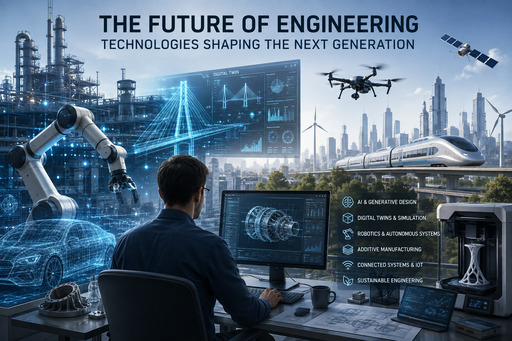
Engineering is entering a new era shaped not by one breakthrough, but by the convergence of multiple technologies. Artificial intelligence, digital twins, advanced robotics, additive manufacturing, and connected systems are changing how engineers design, test, build, and maintain everything from products to critical infrastructure. As these technologies become more integrated, engineering is evolving into a more connected, computational, and AI-assisted discipline.
What Is Driving the Future of Engineering?
Several forces are accelerating the transformation of engineering. Modern products, infrastructure, and industrial systems are becoming more complex, requiring engineers to manage growing volumes of data, interconnected components, and increasingly demanding performance requirements. At the same time, organizations face pressure to shorten development cycles, improve efficiency, reduce costs, and meet more ambitious sustainability goals.
Another major driver is the convergence of physical engineering with digital technologies. Sensors, cloud computing, simulation tools, artificial intelligence, and automation are increasingly integrated into the entire engineering lifecycle—from initial design and testing to production and maintenance.
As a result, the future is not simply digital engineering. It is increasingly intelligent, connected, and autonomous engineering, where physical systems and digital capabilities work together.
1. Artificial Intelligence and Generative AI
Artificial intelligence is becoming one of the most influential technologies in modern engineering. Beyond automating routine tasks, AI can help engineers explore design possibilities, analyze complex systems, identify potential problems, and make faster, data-informed decisions throughout the engineering lifecycle.
Generative Design and Engineering Optimization
Generative AI and AI-driven design tools can evaluate large numbers of design alternatives based on defined requirements such as weight, cost, strength, material use, and manufacturing constraints. Instead of manually developing and comparing every option, engineers can use these systems to identify promising solutions and refine them using their technical expertise.
AI-Assisted Engineering Workflows
AI is also becoming part of everyday engineering workflows. It can support simulation and data analysis, generate technical documentation and code, detect defects, and help build predictive models for equipment performance or maintenance needs. These capabilities can reduce repetitive work and allow engineers to spend more time on complex problem-solving, validation, and decision-making.
From AI Assistants to Autonomous Engineering
The next step may be the emergence of AI agents capable of coordinating multiple engineering tasks, from analyzing requirements to running simulations and evaluating results. This could move engineering from AI-assisted workflows toward increasingly autonomous processes. However, human oversight will remain critical, particularly when decisions involve safety, reliability, regulatory requirements, and complex engineering trade-offs.
2. Digital Twins and Advanced Simulation
Digital twins are changing how engineers understand and manage physical systems. A digital twin is a virtual representation of a physical asset, process, or system that can be updated with real-world data. Unlike a static model, it can reflect changing operating conditions, helping engineers test scenarios and understand system behavior without interfering with the physical asset.
Real-Time Engineering Models
Sensors and connected devices can continuously collect information about factors such as temperature, vibration, pressure, energy consumption, or equipment condition. This operational data feeds the digital representation, giving engineers a more current view of how a system is performing and allowing them to compare actual behavior with expected performance.
Predictive Maintenance and Performance Optimization
Digital twins can remain useful long after the design stage. By analyzing operational data and simulating different scenarios, engineers can identify performance issues, anticipate maintenance needs, and evaluate potential improvements before making changes to the physical system. This can help reduce downtime, extend asset life, and improve efficiency.
AI-Powered Digital Twins
Combining digital twins with AI expands these capabilities further. AI can analyze large volumes of operational data, recognize patterns, predict potential failures, and recommend adjustments. As these systems advance, digital twins can evolve from monitoring tools into intelligent platforms that support continuous optimization and more adaptive engineering decisions.
3. Robotics and Autonomous Systems
Robotics is expanding beyond traditional factory automation. Advances in sensors, artificial intelligence, computer vision, and control systems are enabling machines to operate in more complex environments and collaborate more closely with people. These technologies are finding applications across manufacturing, construction, aerospace, logistics, infrastructure, and inspection.
| Technology | How It Is Used | Engineering Applications |
| Collaborative robots (cobots) | Work alongside people and assist with repetitive, precise, or physically demanding tasks | Assembly, testing, material handling, laboratory work |
| Autonomous machines | Navigate and perform tasks with limited human intervention | Construction equipment, warehouse systems, drones, inspection robots |
| Computer vision systems | Interpret visual data from cameras and sensors | Quality control, defect detection, navigation, infrastructure inspection |
| AI-powered robotics | Use data and AI models to adapt behavior and support decision-making | Advanced manufacturing, predictive maintenance, autonomous operations |
AI and the Next Generation of Robotics
AI is making robotic systems more adaptable. Computer vision allows machines to recognize objects and monitor their surroundings, while machine learning can help them improve performance using operational data. More advanced approaches, including reinforcement learning, can enable robots to learn strategies for complex tasks through interaction and simulation.
For engineers, this shift means robotics is moving from predefined automation toward increasingly intelligent and autonomous systems. Human oversight, however, remains essential when these machines operate in safety-critical or unpredictable environments.
4. Additive Manufacturing and Advanced Materials
Additive manufacturing, commonly known as 3D printing, is changing how engineers approach both design and production. By building components layer by layer, it can enable complex geometries, reduce material waste, and create parts that would be difficult or expensive to manufacture using conventional methods.
Beyond Prototyping
While 3D printing was once used primarily for rapid prototypes, additive manufacturing is increasingly being applied to functional and production-ready components. Industries such as aerospace, automotive, medical technology, and industrial manufacturing can use it to produce lightweight parts, customized components, and complex internal structures while reducing the need for multiple manufacturing steps.
AI-Driven Additive Manufacturing
AI can make additive manufacturing processes more reliable and efficient. Machine learning systems can analyze process data, detect potential defects, optimize printing parameters, and support real-time quality control. Combined with digital twins and sensor data, these capabilities could create closed-loop manufacturing systems that continuously monitor and adjust production conditions.
New Materials, New Engineering Possibilities
Progress in manufacturing is also closely connected to advances in materials science. High-performance composites, lightweight alloys, and smart materials are giving engineers new ways to improve strength, durability, efficiency, and functionality. Combined with additive manufacturing and computational design, these materials can enable components optimized not only for shape, but also for specific operating conditions and performance requirements.
Conclusion
The future of engineering will be defined not only by more advanced tools, but by how effectively engineers use them to solve increasingly complex problems. As engineering becomes more connected, intelligent, and automated, technology can accelerate design, analysis, testing, and decision-making—but it does not eliminate the need for human expertise.
Engineers will continue to define the right problems, evaluate trade-offs, question results, and make decisions where safety, sustainability, cost, and performance intersect. Creativity, critical thinking, and ethical judgment will therefore remain as important as technical skills. The tools of engineering will continue to evolve, but responsibility for turning technological capabilities into practical, reliable, and beneficial solutions will remain fundamentally human.